Semantic ISR on small drones
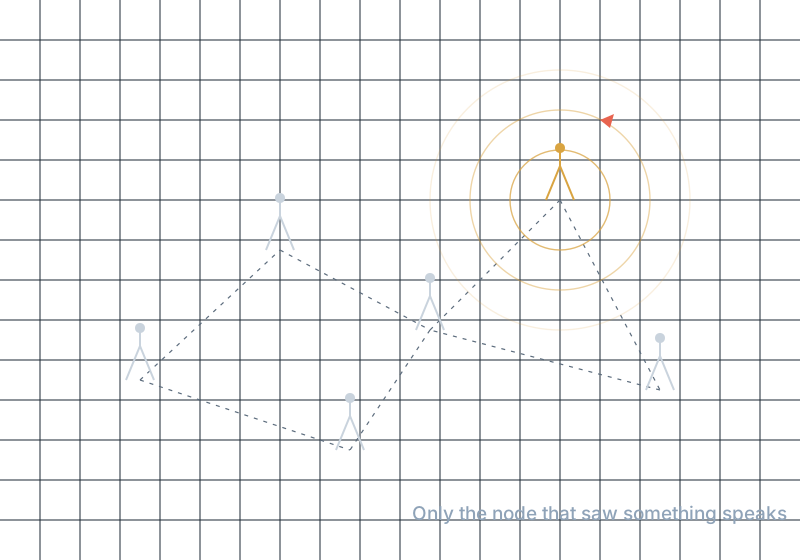
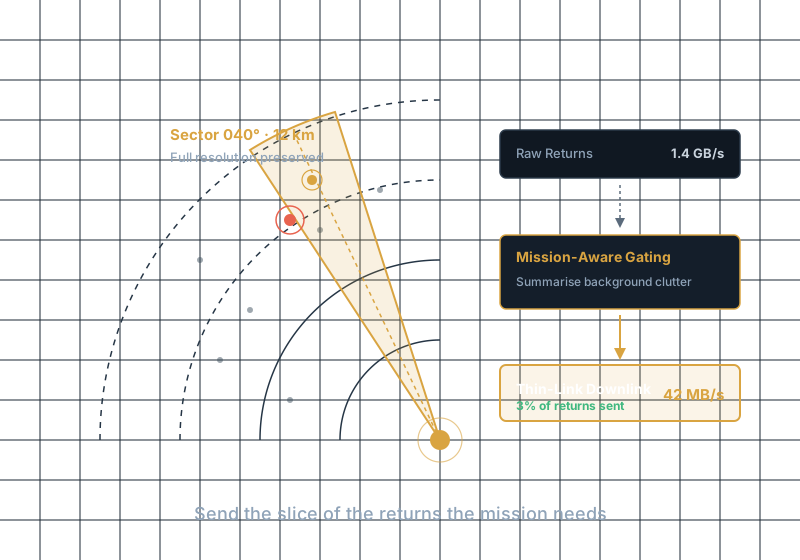
A drone on a thin link should send findings, not video.
What it ignores vs. When it speaks
Tactical edge systems cannot waste compute or bandwidth. The model spends energy only when evidence satisfies strict mission criteria.
What it ignores
People and vehicles doing what the scene does every day. Frames where nothing changed since the last look.
Person loitering at the gate
Stationary 4 min where people usually pass
Evidence: 2 image chips · confidence 0.88
How it decides
Every incoming sensory event moves through four verifiable operational phases:
Ignore
The onboard model learns normal baseline kinematics for each ground sector and ignores routine activity.
Recruit
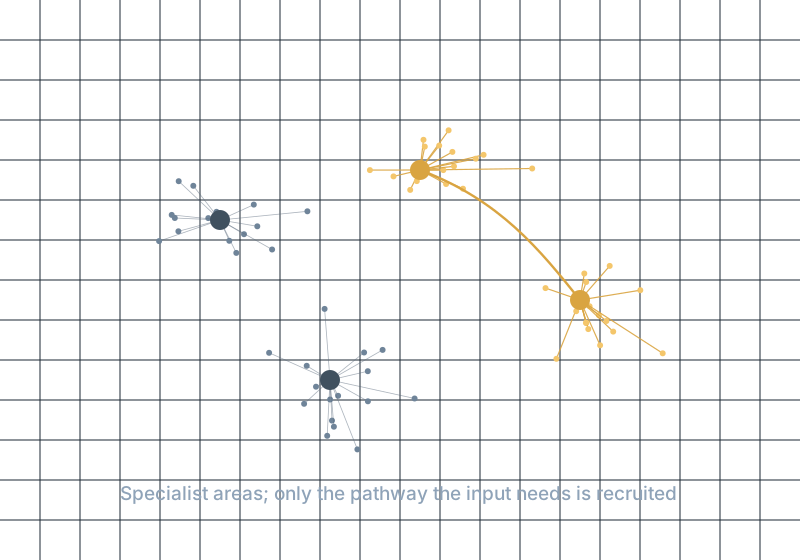
Only tracks exhibiting anomalous behavior (e.g. loitering at a gate) trigger deep mission card checks.
Refuse
If the sensor has not observed a scene long enough to establish normal, it explicitly reports unconfirmed.
Record
Each report transmits a compact semantic packet containing the firing rule, an image chip, and cryptographic hash.
Technical Readiness & Stack Architecture
Measured Benchmark Results
Measured on staged flights: 1 of 7 staged events named with no false alarm, every miss traced to its stage (arXiv:2609.15579).
Interfaces & Deployment
Interoperable Mission Applications
Ready to Evaluate This Pipeline on Your Silicon?
We provide containerized binaries, sample sensor traces, and zero-trust edge benchmarks for pilot programs.