Modular brain-inspired AI
Do not shrink the model. Shrink how much of it has to run.
What it ignores vs. When it speaks
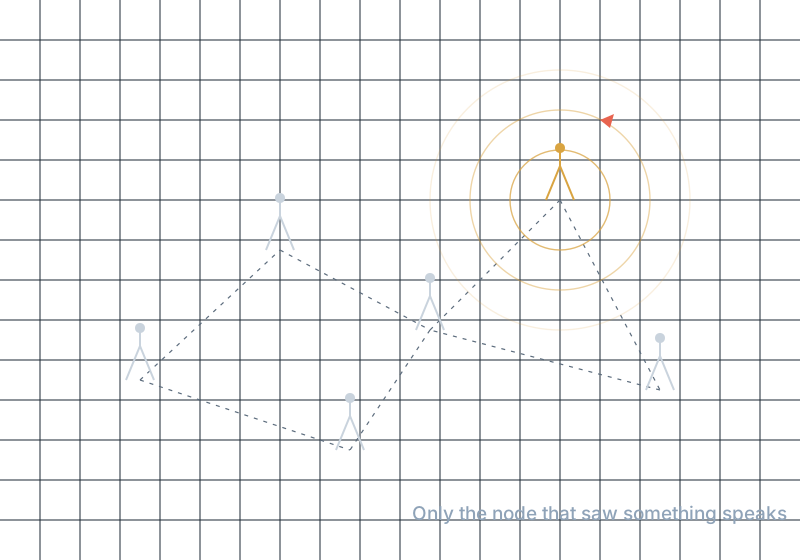
Tactical edge systems cannot waste compute or bandwidth. The model spends energy only when evidence satisfies strict mission criteria.
What it ignores
Inputs the always-on stage rejects. Easy inputs stop after one small specialist.
Vehicle, moving
Pathway: spatial then temporal specialist
Confidence 0.91 · 2.70 J
How it decides
Every incoming sensory event moves through four verifiable operational phases:
Ignore
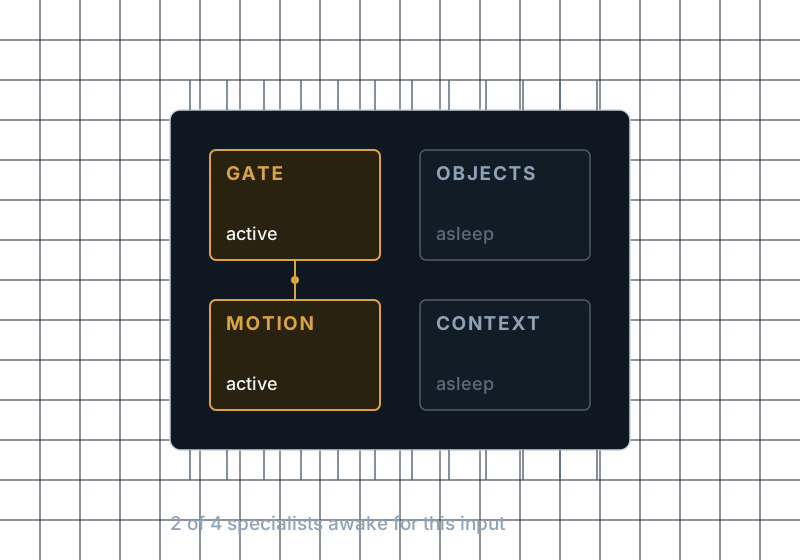
A lightweight, always-on gating stage rejects uninformative background inputs at milliwatt levels.
Recruit
Admitted inputs wake small specialists sequentially only if the preceding specialist is uncertain.
Refuse
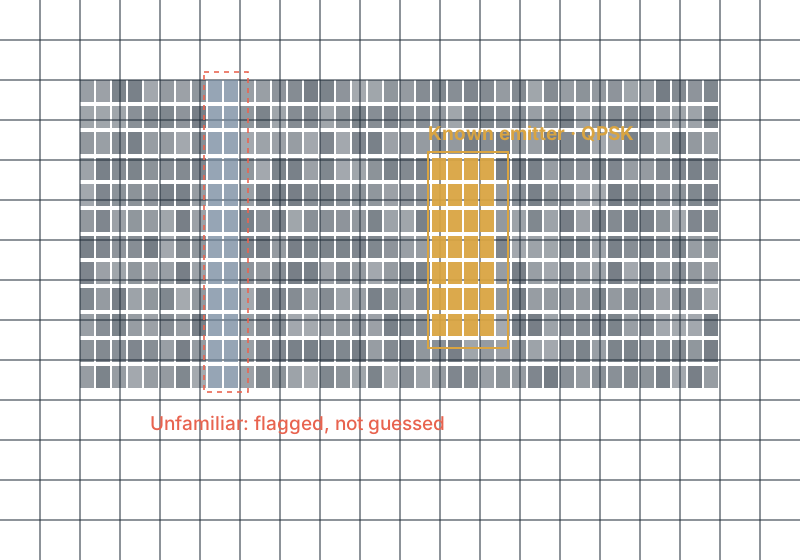
If no admissible specialist pathway fits the remaining energy budget, the system yields an abstention.
Record
An energy ledger records joules consumed alongside the confidence score for every single decision.
Technical Readiness & Stack Architecture
Measured Benchmark Results
Proposed as COLUMNLINE. Phase I would measure joules per correct decision on one board against a single-model baseline.
Interfaces & Deployment
Interoperable Mission Applications
Ready to Evaluate This Pipeline on Your Silicon?
We provide containerized binaries, sample sensor traces, and zero-trust edge benchmarks for pilot programs.