Collaborative radar swarms
Many cheap nodes. Only the one that saw something speaks.
What it ignores vs. When it speaks
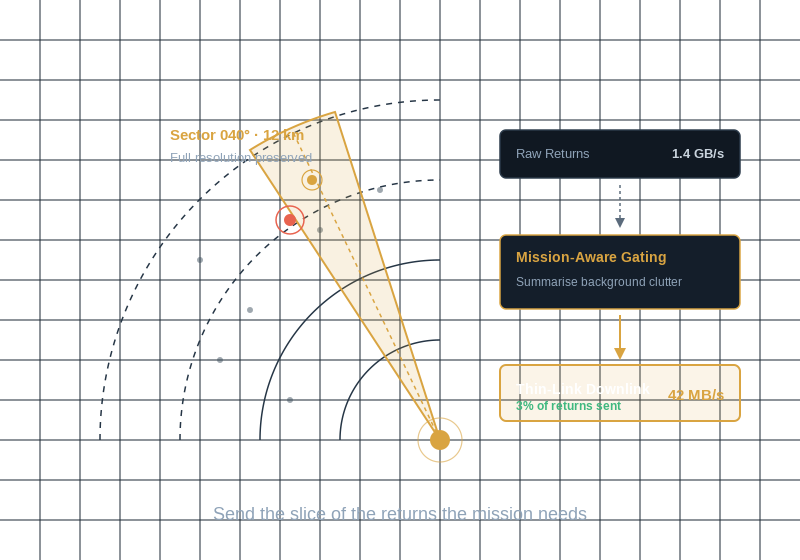
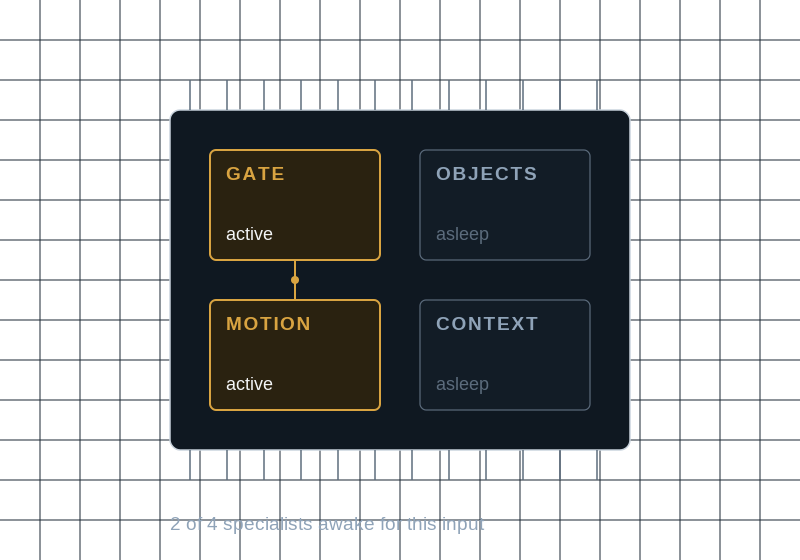
Tactical edge systems cannot waste compute or bandwidth. The model spends energy only when evidence satisfies strict mission criteria.
What it ignores
Clutter and returns every node already agrees on. Tracks that have not changed.
New track, node 3
Shared with 2 neighbours for confirmation
Link cost: one short packet
How it decides
Every incoming sensory event moves through four verifiable operational phases:
Ignore
Clutter and ambient returns that all nodes already agree upon are dropped locally at each sensor.
Recruit
A node detecting a novel return sends a targeted verification packet only to its immediate neighbors.
Refuse
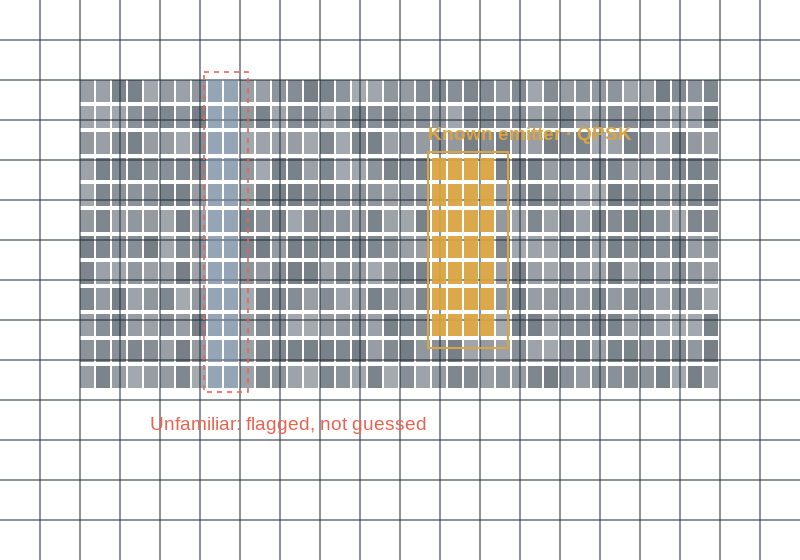
If neighbor nodes fail to confirm the track, it remains marked unconfirmed rather than escalating false alarms.
Record
Every inter-node verification exchange is logged alongside its exact bandwidth and packet cost.
Technical Readiness & Stack Architecture
Measured Benchmark Results
Carried as the second use case in our DAF proposal work. No experiment has run on it yet.
Interfaces & Deployment
Interoperable Mission Applications
Ready to Evaluate This Pipeline on Your Silicon?
We provide containerized binaries, sample sensor traces, and zero-trust edge benchmarks for pilot programs.