
Aerial Person Detection under Edge Constraints: Held-Out Evaluation and Edge-Ground Verification
- 92%
- of frames had the person in a standard detector's top 16 (4K, 117 m)
- +8.8 pts
- recall from re-scoring crops with a larger ground model (post hoc)
- 46,000
- parameters in the small onboard detector
What a small drone can find with its own computer and a narrow radio link, and what a larger model on the ground adds. Measured on held-out data, with the misses reported.
The question
A small drone has little compute, little power and a narrow radio link. This paper is a measurement study of person detection under those limits. It is not a new architecture and it is not an autonomous search system.
- How well does a detector small enough for a Raspberry Pi-class board hold up on places it has never seen?
- How does a standard detector compare, and what does it cost to run?
- How much does a larger model on the ground recover when the drone sends it only its best crops?
What was measured
The primary evaluations and their read-outs were written down before they ran. Anything added later is labeled exploratory or post hoc in the paper, and on this page.
- Thermal imagery: HIT-UAV, 2,898 frames and 12,312 people, split by whole recording blocks.
- Mountain search imagery: HERIDAL, 1,582 frames, 3,091 people and 15 locations after removing duplicate images.
- Our own 4K drone footage of one person, walking and standing still, from about 9 m to 117 m.
- Three systems: a 46,000-parameter onboard detector with a contrast-based gate, the same network applied everywhere, and a standard detector (YOLO11n, 2.6 million parameters).
Findings
- Evaluation protocol matters. Holding out whole recording blocks cut thermal recall at a fixed false-alarm target from 32.7% to 12.3% (exploratory).
- Gating helps the small model, but both versions are weak. The gated detector found 10.4% of people; the same network without the gate found 5.7%.
- A standard detector is better and costs more. YOLO11n found 54.5% at a similar false-alarm rate, for about eleven times the arithmetic.
- At 117 m on 4K footage, tiled YOLO11n had the walking person in its top 16 detections in up to 92% of frames. The onboard model managed 74%.
- Thresholds do not travel. Tuned at one location, YOLO11n exceeded its false-alarm target by 1.7 to 3.4 times at new locations.
- Ground re-scoring recovered some recall. An 842,000-parameter ground model re-scoring the 16 best crops raised recall from 44.9% to 53.7%. The paired gain over 15 locations was +8.8 points (interval +2.4 to +12.5), a post hoc analysis. The change in false detections could not be told apart from zero.
- On a Raspberry Pi 5, gating cut power above idle by 32 to 39%, which is about 6% of whole-board power.
Onboard detector, gated
Same network, no gate
Standard detector (YOLO11n)
Recall at a matched false-alarm target, five folds of held-out recording blocks.
| System | People found | False alarms per frame | Compute per frame |
|---|---|---|---|
| Onboard detector, gated | 10.4% | 0.19 | 0.28 GMAC |
| Same network, no gate | 5.7% | 0.17 | 1.43 GMAC |
| Standard detector (YOLO11n) | 54.5% | 0.14 | 3.2 GMAC |
In the field
We also flew our own 4K footage of one walking person at four heights. The question was simpler than detection: is the person among the 16 crops the drone would send to the ground?
No single setting works at every height. Tiling the frame for the standard detector does best high up and worst close to the ground, where the person fills more than a tile.
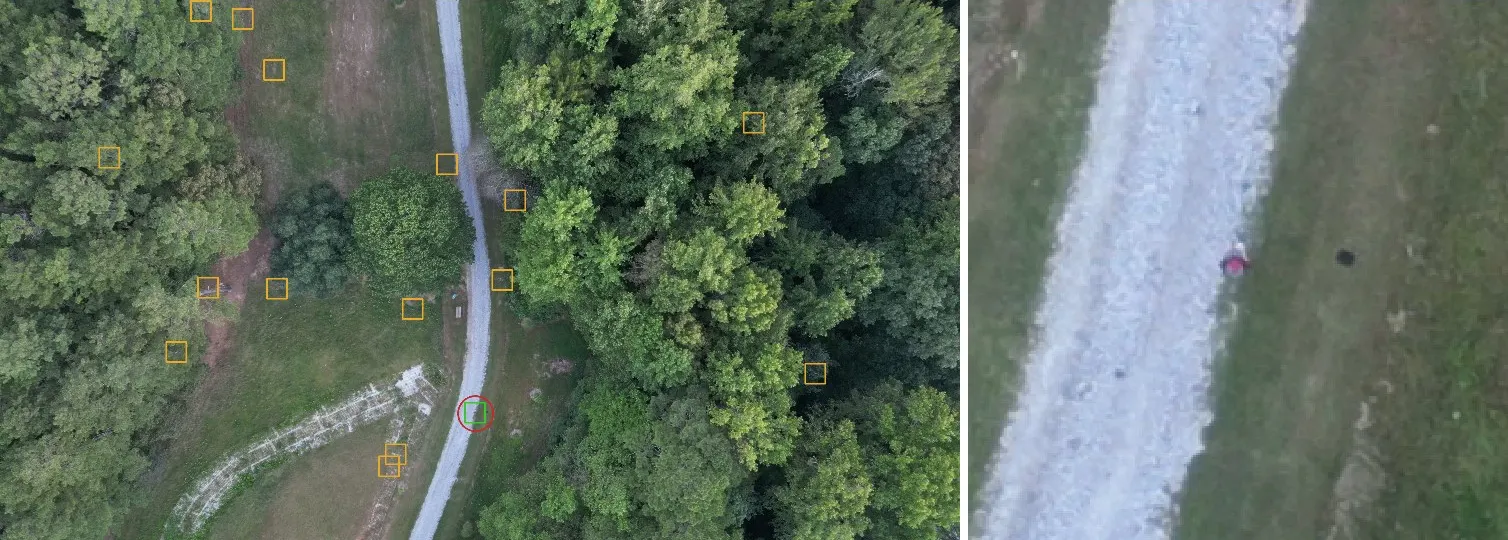
- Onboard model
- Standard detector, tiled
117.5 m
89.2 m
60.3 m
9.3 m
Groups are small (109, 8, 26 and 52 samples) and no intervals were computed. One site, one person.
The misses
- A person standing still in earth-tone clothing was rarely found from 60 m up: 0 to 1% of samples for the onboard model and 0 to 7.5% for the best standard configuration.
- Our own onboard detector loses to the standard detector on accuracy.
- Sending only 16 crops costs coverage. The standard detector's top 16 contained the person 71% of the time, against 81% for all of its detections.
- The crops are a bandwidth cost, not a saving, until they are compared with compressed full frames. That comparison was not measured. Sixteen crops are about 154 KB per frame, roughly 2.46 Mbit/s per drone.
Limits
- The field footage is one site, two afternoons and one or two people, in small groups of samples.
- The ground re-scoring gain comes from one run and a post hoc analysis. It has not been repeated.
- The thermal recording blocks are inferred from frame numbers, not from flight logs.
- Power figures are for the detection pipeline only, on a bench, at one processor setting.
- Nothing here is a claim about the probability of finding a person in a real search.
What comes next
The paper lists the next steps, each to be written down before it is run:
- Measure the standard detector on the Raspberry Pi 5: latency, energy and temperature.
- Choose the input size from altitude, using the drone's own telemetry.
- Repeat the ground re-scoring test with the paired analysis declared in advance and a second run.
- Collect more field data, and test a detector with a permissive license.
Keep reading
Semantic ISR on small drones
PageWhat a gated sensing pipeline never looks at
ResearchAll research
ResearchDiscuss the evidence.
Tell us the decision you need to support. Our engineers reply directly.
Start a conversation