Carrier arresting gear health
Name the failing part before the next trap.
What it ignores vs. When it speaks
Tactical edge systems cannot waste compute or bandwidth. The model spends energy only when evidence satisfies strict mission criteria.
What it ignores
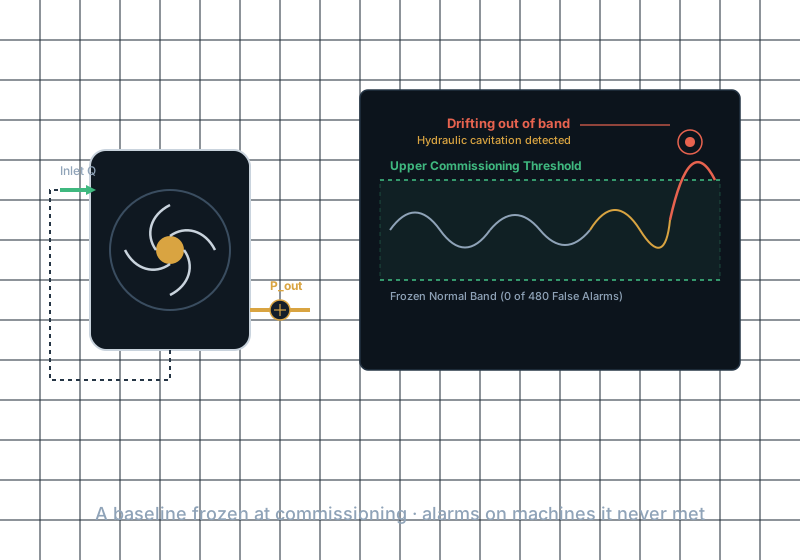
Healthy vibration. Regimes the monitor was never commissioned on, which it refuses to score.
Inner race defect
Peak at 5.4× shaft speed, above frozen baseline
Name the part · 0.75 s window
How it decides
Every incoming sensory event moves through four verifiable operational phases:
Ignore
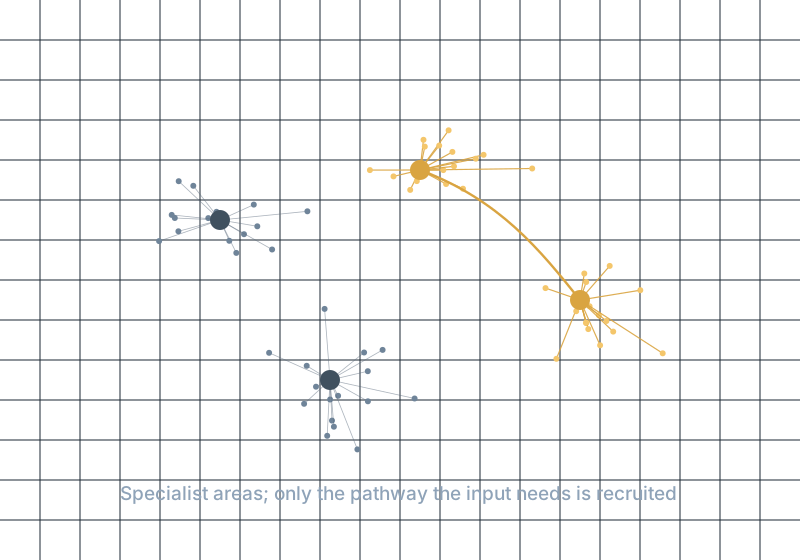
Routine healthy vibration is ignored; uncommissioned operating regimes are refused from scoring.
Recruit
Bearing geometry equations derive expected defect frequencies (e.g. 5.4× shaft speed) in 0.75s windows.
Refuse
Without a valid baseline for the current operational regime, the engine declines to generate false alarms.
Record
Every alarm explicitly names the Lowest Replaceable Unit (LRU), frequency peak, and spectral evidence.
Technical Readiness & Stack Architecture
Measured Benchmark Results
On public CWRU data: race faults 15 of 18 correct with no misattribution and no false alarms. Ball faults are not solved yet.
Interfaces & Deployment
Interoperable Mission Applications
Ready to Evaluate This Pipeline on Your Silicon?
We provide containerized binaries, sample sensor traces, and zero-trust edge benchmarks for pilot programs.